
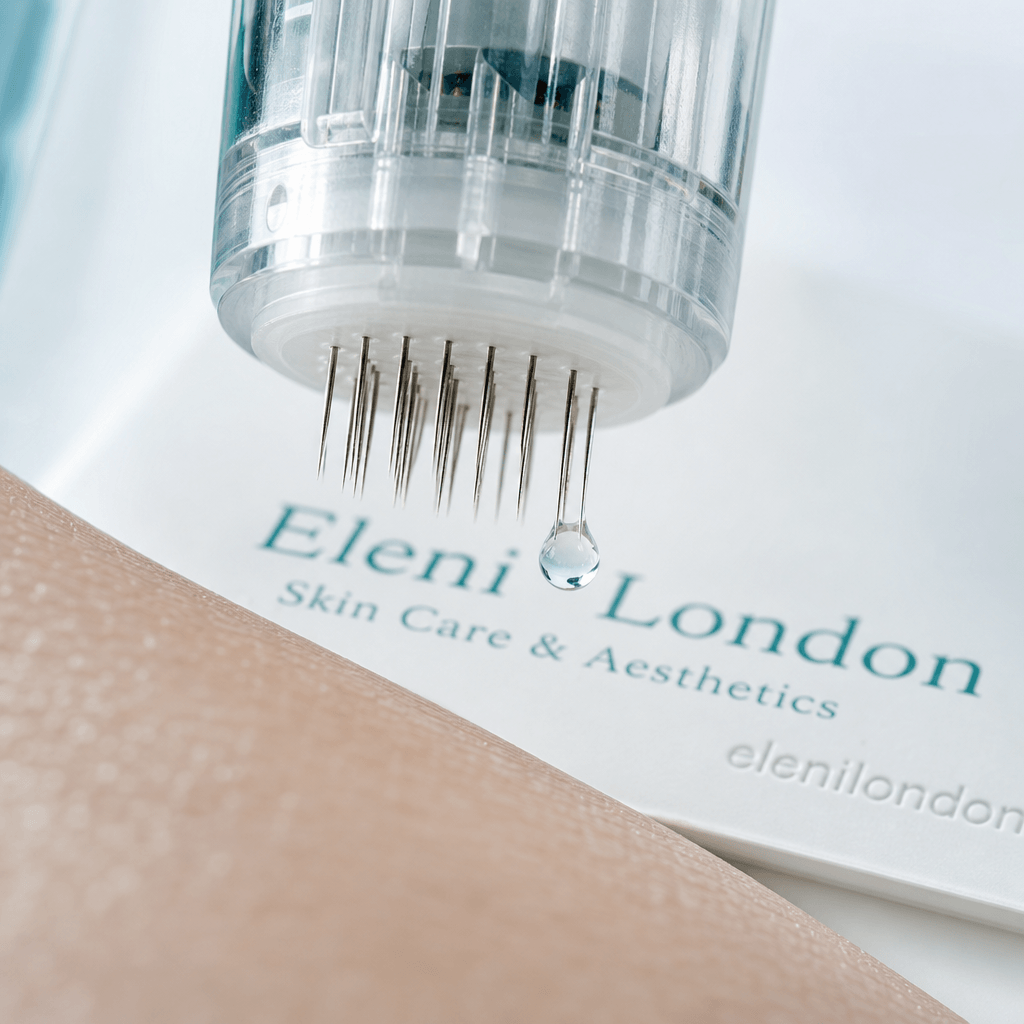
Your skin is remarkably intelligent. When it sustains controlled, precise injury, it does not simply repair itself and move on. It rebuilds, restructles, and in doing so, produces something better than what was there before. This is the central principle behind collagen induction therapy (CIT), a treatment that has earned genuine respect in professional skincare circles, and one we work with regularly here at Eleni London Skin Care and Aesthetics.
If you have ever wondered why a treatment that intentionally causes micro-damage to the skin can result in smoother, firmer, more youthful-looking results, this post will walk you through exactly what is happening beneath the surface.
What Collagen Induction Therapy Actually Is
Collagen induction therapy is a minimally invasive procedure that uses fine needles to create thousands of microscopic punctures across the surface of the skin. These punctures are carefully controlled in both depth and distribution. The skin does not experience them as harmful damage in the traditional sense. Instead, it registers them as a wound signal, and the cascade of healing responses that follow is precisely what makes this treatment so effective.
The process is also widely referred to as microneedling, though CIT is the more clinically accurate term when the primary goal is stimulating the body's own collagen production rather than simply creating channels for topical product absorption.
The Biology of Controlled Skin Trauma
Understanding why CIT works requires a brief look at how the skin responds to injury. When the dermis, which is the deeper structural layer beneath the surface, detects damage, it immediately initiates a three-phase healing response.
Phase one is inflammation. Blood flow increases to the area, and the immune system dispatches cells to assess and address the disruption. This is why treated skin appears temporarily red and feels warm. Far from being a side effect to worry about, this inflammatory response is the starting point of everything beneficial that follows.
Phase two is proliferation. During this stage, the skin begins producing new cells and, critically, new collagen and elastin fibres. Fibroblasts (the cells responsible for producing structural proteins) become highly active. The body lays down fresh collagen in a more organised matrix than aged or sun-damaged skin typically contains.
Phase three is remodelling. Over the weeks and months following treatment, this new collagen matures and aligns itself more effectively. The skin gradually becomes firmer, plumper, and more resilient. This is why results from CIT continue to improve well after the initial session, sometimes for up to six months.
What Collagen Induction Therapy Can Address
The applications for CIT are broader than many people initially realise. Because the mechanism of action (stimulating the dermis to regenerate) is fundamental to so many skin concerns, it tends to be a versatile option across different skin types and age groups.
At Eleni London Skin Care and Aesthetics, we often see clients seeking CIT for the following concerns:
Fine lines and laxity. As we age, natural collagen production slows considerably. By the time most people reach their mid-thirties, the skin is producing less collagen than it loses each year. CIT interrupts this decline by prompting fresh synthesis, making it particularly relevant for age-appropriate skincare planning.
Acne scarring. Post-acne scarring involves disrupted collagen architecture in the dermis. CIT encourages the skin to break down and remodel this disorganised tissue, progressively softening the appearance of pitted or textured scars.
Uneven skin tone and texture. The micro-channels created during treatment also support the skin's natural exfoliation and renewal cycle, which can result in a more uniform tone and refined surface texture over time.
Stretch marks. Like acne scars, stretch marks represent areas where the dermis has undergone structural change. CIT introduces a controlled stimulus that encourages the skin to revisit and repair these areas.
Why Precision and Professional Oversight Matter
The principle of controlled trauma only holds when the control element is genuinely present. Needle depth, device quality, aftercare protocol, and the individual's skin condition at the time of treatment all significantly influence outcomes. Too shallow, and the stimulus is insufficient to trigger meaningful collagen synthesis. Too deep, or applied without proper assessment, and the risk of unintended damage increases considerably.
This is why, at Eleni London Skin Care and Aesthetics, every CIT consultation begins with a thorough skin analysis. With over four decades of experience in the aesthetics industry, our approach has always been grounded in the understanding that no two clients have identical skin. The depth, frequency, and supporting treatments we recommend are specific to each person, their skin history, and their goals.
It is also worth noting that CIT is not appropriate for all skin conditions or all stages of skin health. Active acne breakouts, certain inflammatory conditions, and specific medication histories may affect suitability. This is another reason professional assessment is not optional, it is foundational to safe and effective treatment.
What to Expect Before, During, and After
Before a session, the skin is typically cleansed and a topical numbing agent is applied to ensure comfort. The treatment itself takes between 30 and 60 minutes depending on the area being treated. Most clients describe the sensation as a mild pressure rather than discomfort.
In the 24 to 72 hours following treatment, redness and minor swelling are normal and expected. The skin may feel slightly sensitive, similar to mild sunburn. Avoiding sun exposure, harsh actives such as retinoids or acids, and heavy makeup during this window is strongly advised. Gentle hydration and SPF protection are the priorities in the immediate aftercare period.
Visible improvement typically becomes noticeable within two to four weeks of the first session, as the proliferative phase of healing progresses. For more significant concerns such as deeper scarring or more advanced skin laxity, a structured course of treatments spaced four to six weeks apart will generally deliver more meaningful results than a single session.
A Considered Approach to Long-Term Skin Health
What makes CIT particularly aligned with our philosophy at Eleni London Skin Care and Aesthetics is that it works with the skin rather than simply acting upon its surface. It does not mask. It does not suppress. It invites the skin's own regenerative intelligence to do what it is already capable of doing, just with more intention and direction.
Healthy, radiant skin has always been central to our work. We believe it contributes meaningfully to how our clients feel in their daily lives, and treatments like CIT, approached with knowledge and care, are one of the ways we support that.
If you would like to discuss whether collagen induction therapy is appropriate for your skin concerns, or if you are simply curious about where it might fit within a broader skincare plan, we would welcome the conversation. Visit elenilondon.com to learn more about our treatments and to get in touch with our clinic on Northcote Road in Battersea.